Compute infrastructure, built for the ocean.
Offshore Compute Systems develops modular, marine-engineered data centers designed for deployment on existing offshore and maritime infrastructure — bringing compute to power and water instead of the other way around.
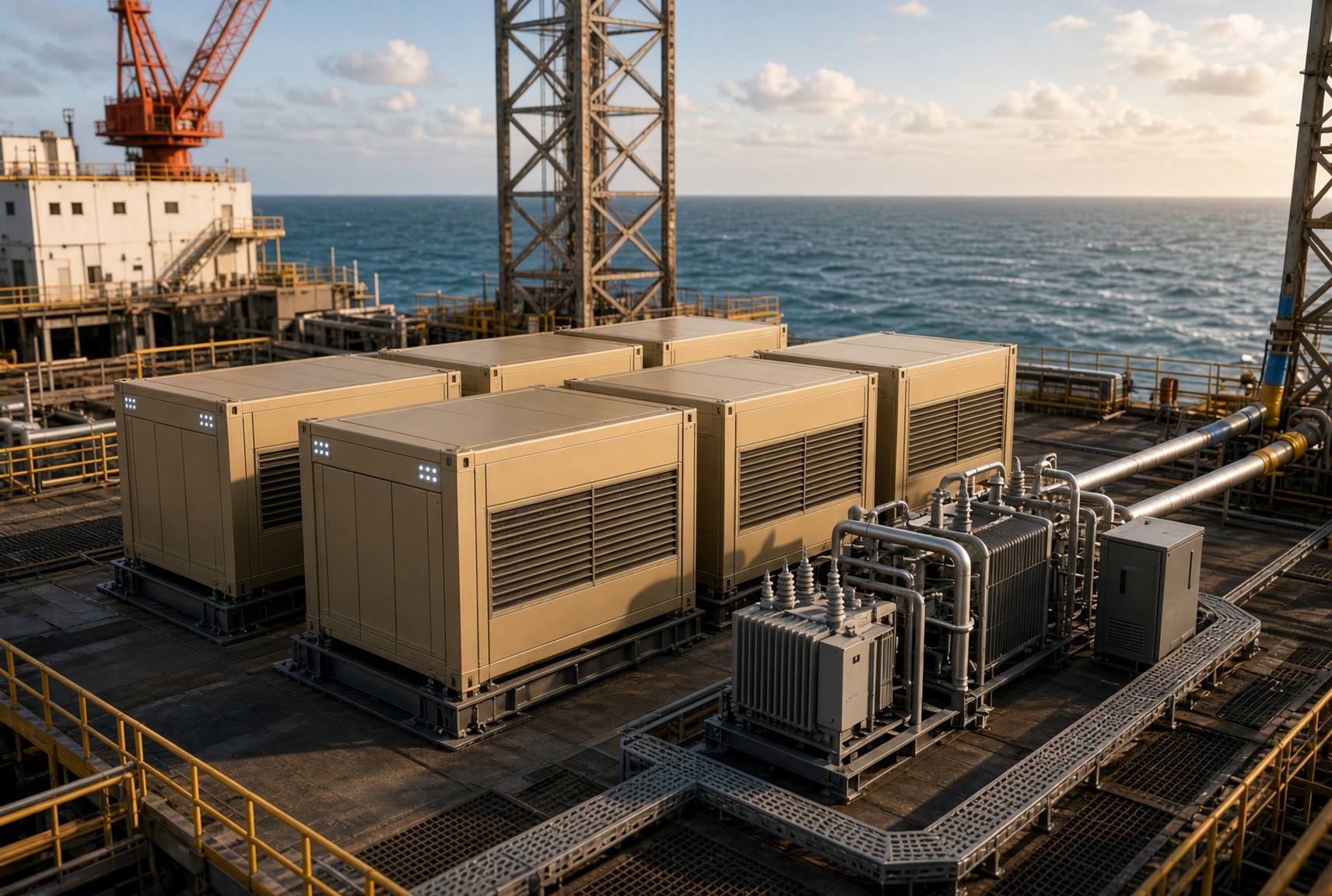
Power
Integrate with existing generation, fuel gas, or dedicated generation systems.
Cooling
Closed-loop liquid cooling with seawater heat rejection.
Connectivity
Offshore fiber, microwave, and redundant communications.
Modularity
Deploy incrementally from pilot-scale systems to multi-megawatt facilities.
Compute demand is outrunning where infrastructure can go.
Growth in AI and high-performance computing requires enormous amounts of power and physical infrastructure. Conventional data-center development increasingly runs into constraints that have little to do with the compute itself.
- Utility interconnection constraints
- Land requirements
- Electrical infrastructure lead times
- Cooling requirements
- Permitting complexity
- Transmission constraints
Bring compute to existing energy and maritime infrastructure, rather than bringing all infrastructure to compute.
Offshore Compute Systems is exploring a different infrastructure model — not a claim that offshore siting eliminates these constraints, but that it changes which ones apply.
A defined path from prototype to platform.
Each stage is designed to validate the next before scale increases.
Marine Prototype
- Demonstrate marine operation
- Validate cooling
- Test corrosion protection
- Test remote management
- Test connectivity
- Collect environmental & operational telemetry
Commercial Pilot
- First offshore commercial deployment
- Real customer workloads
- Validate uptime & maintenance model
- Establish offshore operating procedures
Commercial Platform
- AI inference & training
- High-performance computing
- Scientific computing
- Energy-industry workloads
Create new value from offshore infrastructure.
Offshore Compute Systems is evaluating ways to install modular compute systems alongside existing offshore operations — without disrupting them.
Compute hosting does not automatically extend lease life or eliminate decommissioning obligations. Any post-production arrangement is evaluated on its own regulatory and commercial merits.
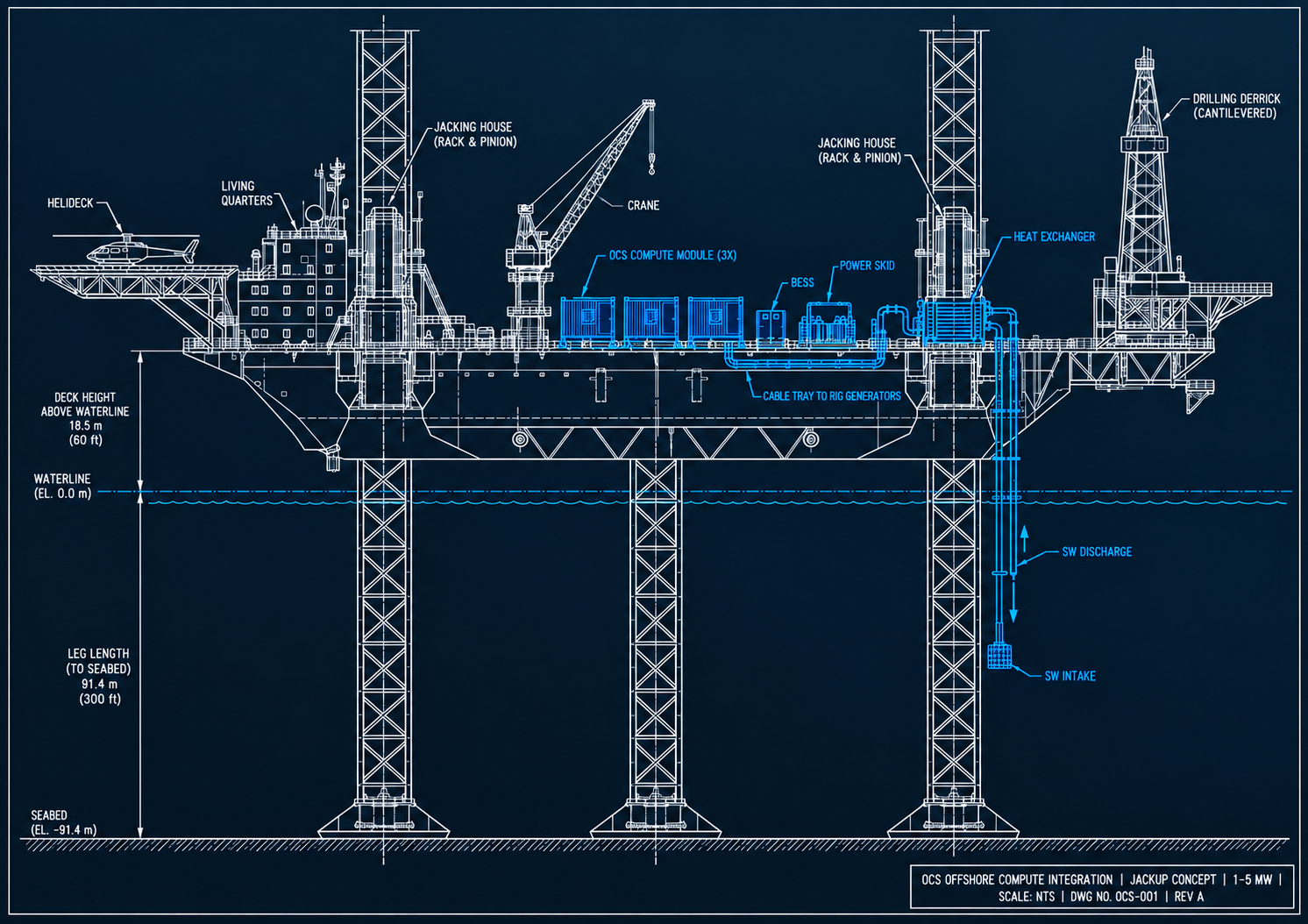
Conceptual illustration of a jackup-platform integration — layout and dimensions shown are illustrative only, not a specification for any particular deployment.
Oil & Gas Operations
Operated by the platform owner. Petroleum operations remain fully separate and unaffected.
Compute Operations
Operated by Offshore Compute Systems. Independent power tie-in, cooling, and network path.
Possible commercial structures include a fixed annual hosting payment, a power purchase agreement, a fuel-gas agreement, a revenue share, a joint venture, or a long-term site agreement — structured around what fits the asset and the operator.
A collaborative marine engineering and compute research platform.
Built for maritime academies and research institutions.
Institution provides
- Waterfront space
- Reasonable access
- Power connection
- Potential seawater access
- Faculty / student participation
OCS provides
- Compute hardware
- Cooling system
- Marine enclosure
- Installation & maintenance
- Monitoring & engineering support
- Allocated GPU capacity for research
One possible evolution for offshore infrastructure.
Any post-production reuse would require regulatory approvals and appropriate commercial arrangements — this is a conceptual trajectory, not a commitment on any specific asset.
Active energy asset
Platform operates in standard oil & gas production service.
Hybrid energy + compute asset
Compute modules operate alongside ongoing production, using spare capacity.
Compute-focused infrastructure
Late-life or decommissioned structures potentially repurposed, subject to regulatory approval.
The subsystems, briefly.
Compute SYS.01
Modular GPU servers designed to support current and future accelerator generations — not tied permanently to a single hardware platform.
Cooling SYS.02
- Closed-loop direct-to-chip / liquid-cooled architecture
- Secondary seawater heat exchanger
- Redundant pumps
- Marine-grade materials
Power SYS.03
- Existing offshore generation
- Fuel-gas generation
- Dedicated natural-gas generation
- Shore power where available
- Batteries / UPS for ride-through & controlled shutdown
Networking SYS.04
- Primary subsea fiber where practical
- Microwave or secondary fiber redundancy
- Satellite for management / fallback
Marine Engineering SYS.05
- Corrosion protection
- Salt-air isolation
- Vibration
- Humidity control
- Hurricane conditions
- Fire suppression
- Hazardous-area separation
- Remote monitoring
- Structural integration
Built by Maritime Academy graduates.
Zach Bianchi
Maritime Academy graduate with prior offshore oil & gas experience, including work involving Shell’s Auger platform and the Transocean Deepwater Poseidon. Currently works in energy infrastructure and battery-energy-storage-system supply chains.
LinkedIn ↗Michael Aras
Maritime Academy graduate with a background in data analysis, software development and architecture, automation, power-generation systems, and remote diagnostics — building and maintaining enterprise software platforms.
LinkedIn ↗We are seeking partners across:
Build with us offshore.
Tell us who you are and what you’re working on. We respond to every serious inquiry.